


SPECIAL SITUATIONS ANALYSIS
The forgotten bonds
ELECAR and VENZ Oil Warrants · October 2026 · Madrid, Spain
ELECAR 8.5 04/10/18 Corp – Overview
ELECAR, a former PDVSA company
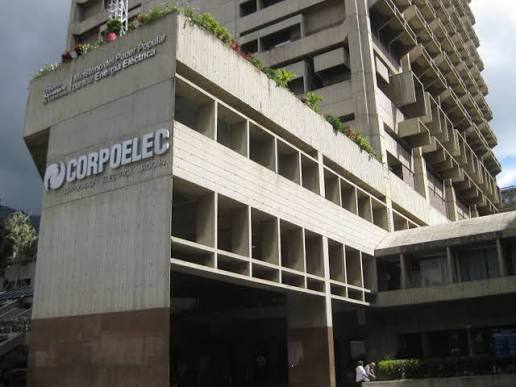
Founded in 1895, C.A. La Electricidad de Caracas (ELECAR) was one of Venezuela’s largest and oldest electricity utilities. In 2007, PDVSA acquired an 82% stake from AES, reaching 93.62% by December. PDVSA’s control was transitional. Decree N° 5,330, dated May 2, 2007, nationalized the electricity sector, ending private ownership, and created Corporación Eléctrica Nacional (Corpoelec).
The decree required PDVSA to transfer its ELECAR shares to Corpoelec and set May 2010 as the deadline for all subsidiaries, including ELECAR, to merge into it. A 2010 reform extended the deadline to December 30, 2011, after which Corpoelec became Venezuela’s sole electricity provider.
Legal implication: ELECAR is not guaranteed by PDVSA or the Republic
Stakeholder’s incentives
Strategic Holders
Publicly available information shows that a single VCC member holds 31.62% of the issuance, a concentration far from coincidental.
A position of this size, held by a committee member, gives the creditor group a dominant stake in ELECAR and positions it as a pivotal player in any restructuring or enforcement action.
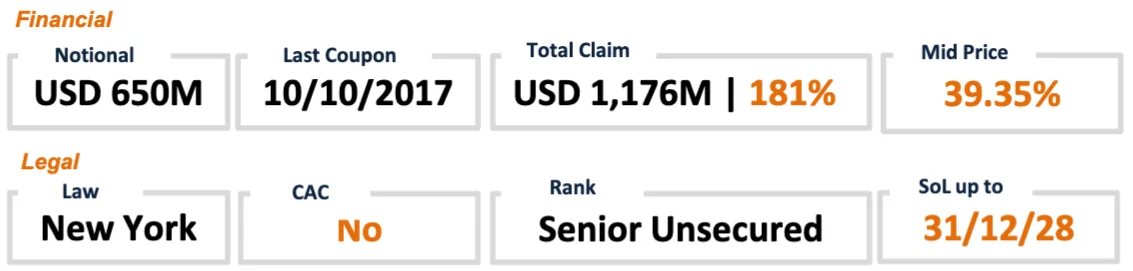
Statute of Limitations: ELECAR 8.5 18 – XS0356521160
In April 2024, the Venezuelan AN15 and a group of VCC member creditors announced a voluntary tolling agreement, extending the SOL to December 31, 2028. Bondholders now retain their legal rights, keeping enforcement and restructuring options alive. The tolling was recognized by New York’s Supreme Court (Index No. 651866/2024) that same year.
Tolling agreement inclusion suggests ELECAR is being treated as part of the restructuring perimeter.
Pricing – Low liquidity, high value
ELECAR’s high concentration, while positive for restructuring purposes, has a caveat: it also limits supply.
With a third of the float locked up and the rest spread across a handful of hedge funds and large real-money accounts, the bond trades in odd lots rather than size.
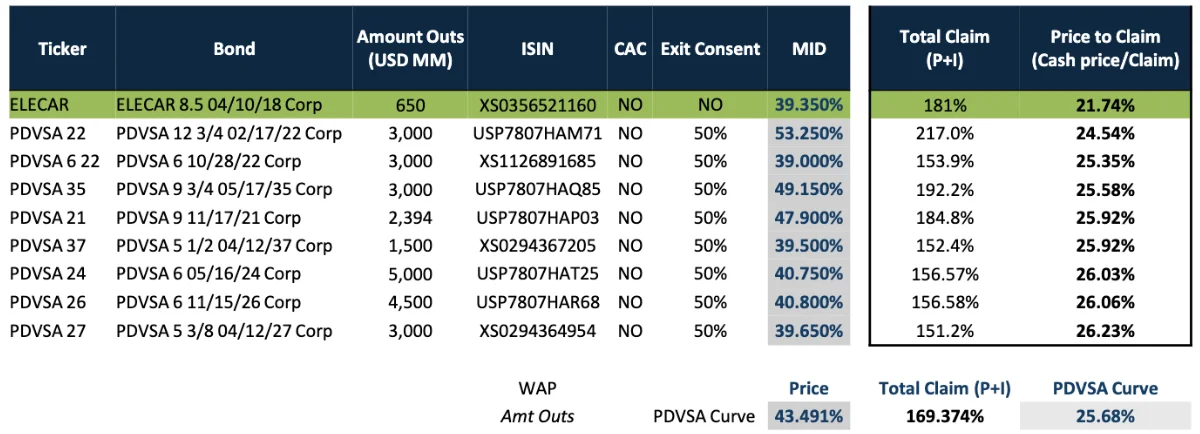
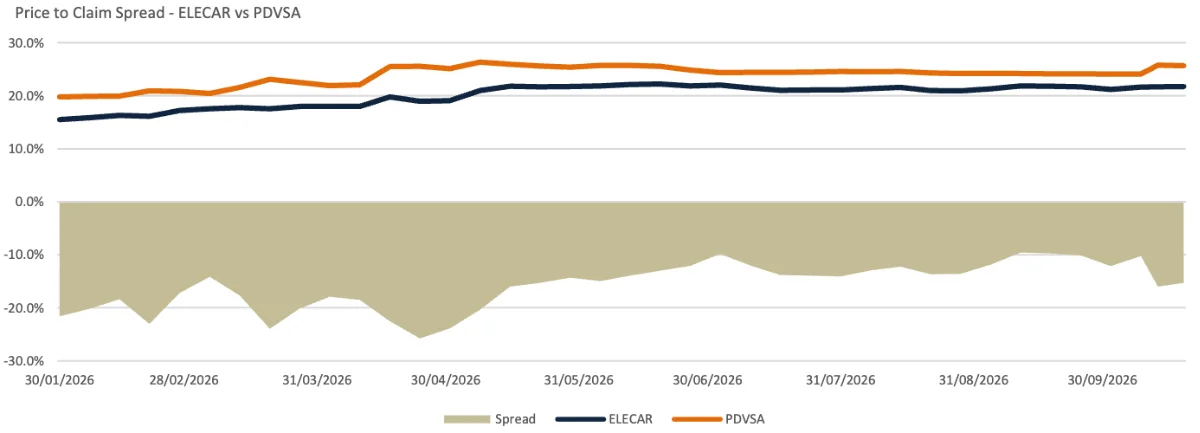
Despite that, the instrument still trades at a considerable discount: 21.74% price to claim, 15% below PDVSA’s 25.68%. Scarce supply would normally support the price. That the discount persists suggests the market is pricing ELECAR’s illiquidity and separate-obligor risk.
VENZ 0 PERP Corp – Overview
The Oil Warrants – a Brady Era legacy
In 1990, Venezuela restructured its commercial bank debt under the Brady Plan. Alongside the new bonds, the Republic issued Oil Warrants: value recovery instruments that gave creditors a share of the upside if oil prices recovered.
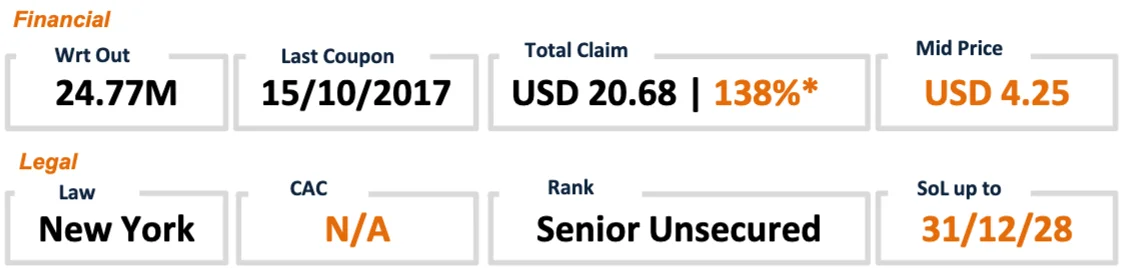
Payments were triggered when Venezuela’s oil export price exceeded a strike price adjusted for US producer-price inflation. They were capped at USD 3 per payment, due semiannually until 2020, and subject to a force majeure clause. The warrants are governed by New York law, with submission to jurisdiction and waivers of sovereign immunity in line with the Republic’s bonds. The Brady bonds themselves are gone; a large share was redeemed early in 2006.
The Oil Warrants are the only instrument from that deal still outstanding. Payments stopped in April 2018, leaving about USD 512mn in unpaid amounts outstanding.
Expected Rank: pari passu to the Republic’s bonds
Statute of Limitations: Oil Warrants (XS0029484945)
The warrants were issued under Venezuela’s 1990 Fiscal Agency Agreement and matured on April 15, 2020. Venezuela missed five payments of USD 3: April 15, 2018, October 15, 2018, April 15, 2019, October 15, 2019 and April 15, 2020.
Litigation: On October 11, 2023, a group of VCC member creditors filed suit against the Republic in the New York Supreme Court (Index No. 655071/2023). The suit names the warrants, listed as “0% 2020 Bonds” under the 1990 FAA, alongside the Republic’s other defaulted bonds. Plaintiffs seek all unpaid amounts plus 9% New York statutory prejudgment interest on unpaid interest. Filing stops the clock, but only for the plaintiffs.
Unilateral tolling: On August 8, 2023, the 2015 National Assembly declared that all limitation periods under New York law on Republic bonds are suspended until December 31, 2028. The declaration expressly preserves the Republic’s other defenses and urges holders not to sue.
*Claim = USD 15 (5 missed payments at the USD 3 cap, per fiscal agent notices) + carry at 12M LIBOR + 0.8125% [fallback: 12M Term SOFR + 0.7151% (ISDA adjustment) + 0.8125% = +1.53% after June 2023] = USD 20.68 (137.9%).
Contractual rate used; plaintiffs claim 9% statutory interest, which would imply a higher claim.
Pricing – Lower liquidity, Higher value
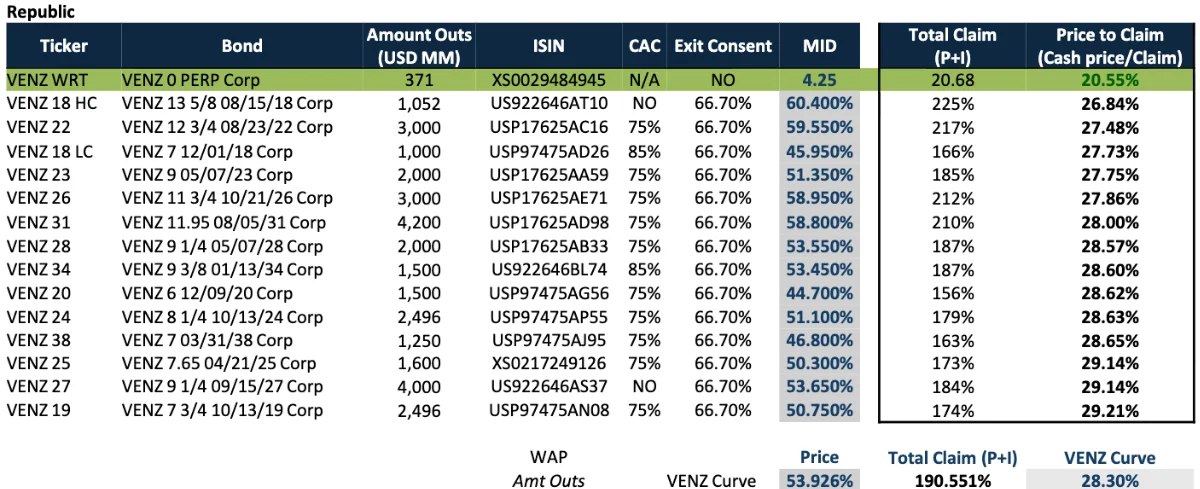
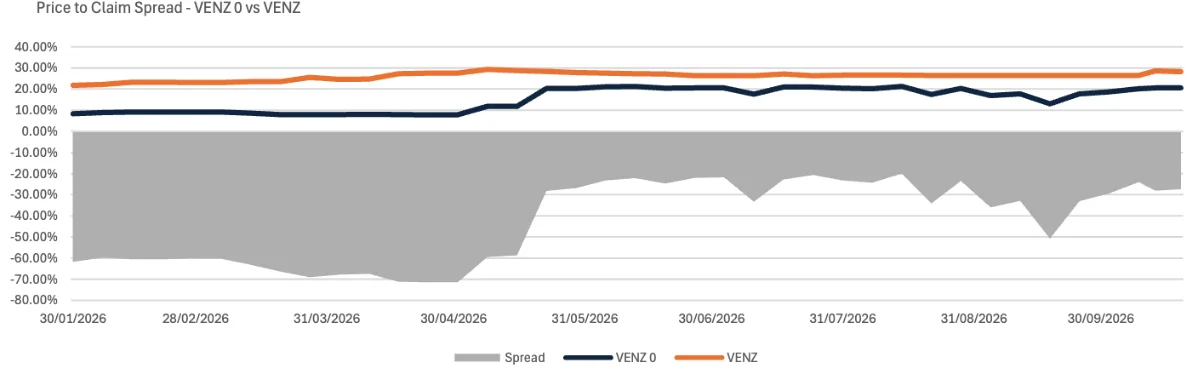
The Oil Warrants face the opposite problem: they are not scarce, they are dormant. The instrument hardly trades, screen prices can sit unchanged for weeks, and flow comes in occasional blocks rather than regular clips: the desk traded between 100k and 1MM units last year. Its Brady-era, oil-indexed structure sits outside standard EM debt mandates, which narrows the natural buyer base. The result is the widest discount in the complex: 20.55% on a price to claim basis, 27% below VENZ’s curve at 28.30%. It reflects the absence of a market that prices the instrument regularly, and the uncertainty over how its claim is calculated.
CONTACT
Rubens Bozano – Special Situations Analyst
rbozano@caledonia.es
Disclaimer
This publication has been approved by Caledonia Sociedad de Valores (“Caledonia”). It is provided to our clients for information purposes only and Caledonia makes no express or implied warranties and expressly disclaims all warranties of merchantability or fitness for a particular purpose or use with respect to any data included in this publication.
The views in this publication are those of the author(s) and are subject to change and Caledonia has no obligation to update its opinions or the information in this publication. If this publication contains recommendations, those recommendations reflect solely and exclusively those of the authoring analyst(s) and such opinions were prepared independently of any other interests, including those of Caledonia.
This publication does not constitute personal investment advice or consider the individual financial circumstances or objectives of the clients who receive it. The securities discussed herein may not be suitable for all investors.
Caledonia recommends that investors independently evaluate each issuer, security or instrument discussed herein and consult any independent advisors if they believe necessary. The value of and income from any investment may fluctuate from day to day because of changes in relevant economic markets (including changes in market liquidity). The information herein is not intended to predict actual results, which may differ substantially from those reflected.
Past performance is not necessarily indicative of future results.
Caledonia Sociedad de Valores, S.A. is authorised and registered with the Comisión Nacional del Mercado de Valores (CNMV) under number 322. Registered office: Calle Serrano 21, 28001 Madrid, Spain.